
Once upon a normal Nigerian conversation, a man clears his throat and announces with moral authority:
“I don’t like bleaching. Natural is best.”
Five minutes later, his Instagram explore page is a United Nations summit of light-skinned women.
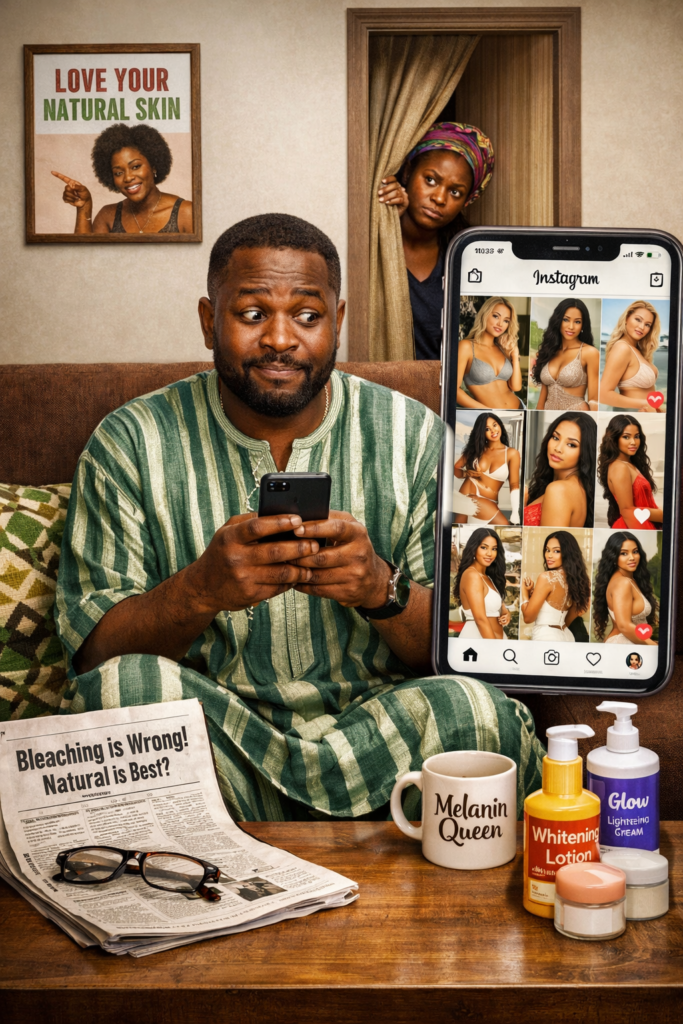
Welcome to Nigeria’s most delicate contradiction, where melanin is praised in theory but filtered in practice.
Skin tone discussions in Nigeria aren’t new. What’s new is how loudly everyone insists they’re not part of the problem… while actively auditioning for it.
If this were a Netflix special, it would be titled:
“From the Other Side of the Mouth.”
🧨 The Core Drama: Preference vs. Public Morality
Let’s establish some uncomfortable facts:
• Many Nigerian men openly or quietly prefer light-skinned women.
• The same men passionately condemn bleaching.
• Dark-skinned women are praised with words like “strong,” “queen,” and “African” but they are not always chosen.
Preference is framed as “taste,”
Bleaching is framed as “immorality,”
And somehow the connection between the two is aggressively ignored.
This is not confusion.
This is selective accountability.
🌗 Other Issues Nobody Likes to Say Out Loud
💡 1. “It’s Just Preference” Is Not Neutral
Preferences don’t form in a vacuum.
When:
• Light skin is called “fine”
• Dark skin is called “beautiful too” (notice the too)
One is clearly the default, the other a consolation prize.
💡 2. The Hypocrisy Olympics
Men say:
“Why can’t women be comfortable in their skin?”
But also say:
• “She’s pretty for a dark girl”
• “If she was fair she’d be a 10”
• “I like chocolate… but not too dark”
Sir. Please sit down.
💡 3. Society Punishes the Result, Not the Cause
Bleaching didn’t appear out of boredom.
It grew out of:
• Media bias
• Marriage preferences
• Workplace advantages
• Compliments tied to complexion
Then society turns around and shames the women who respond to those pressures while applauding the standards that created them.
That’s not morality. That’s gaslighting.
💡 4. The “Natural Is Best” Performance
“Natural is best” is often said loudly
but practiced quietly… on someone else.
The truth?
• Dark-skinned women are encouraged to “embrace themselves”
• While lighter women are actively pursued, praised, and prioritized
Encouragement without equal desire is not empowerment.
💡 5. Women Carry the Consequences
Men debate preferences.
Women deal with:
• Colorist comments
• Reduced dating options
• Family pressure
• Skin-damaging products
• Long-term health risks
One side talks.
The other side pays.
😂 Why People Laugh (Before Getting Serious)
This conversation trends because:
• Almost every Nigerian woman has experienced it
• Almost every Nigerian man has denied it
• Everybody knows that guy who “hates bleaching” but dates only fair women
The jokes land because the reality is familiar.
🧠 Lessons We Can Learn (Without Shouting “Woke” or “Feminist”)
💡 1. Preferences Are Not Immune to Critique
You’re allowed to have them: people are allowed to question where they come from.
💡 2. You Can’t Condemn Bleaching While Rewarding Its Results
You can’t shame the symptom and celebrate the outcome.
💡 3. Dark Skin Doesn’t Need Rebranding
It needs equal desirability, not motivational speeches.
💡 4. Silence Is Also a Choice
Laughing along, staying quiet, or saying “it’s not that deep” helps the system survive.
📌 Final Thought
Nigeria’s skin tone debate isn’t really about complexion, it’s about:
• Who is desired
• Who is tolerated
• And who is asked to “just be confident” without being chosen
You can preach against bleaching all you want
but until attraction, praise, and opportunity are evenly distributed,
the contradiction will remain loud.
Because you can’t shout “love yourself”
while whispering “but not like that.”
And Nigerians will keep laughing,
not because it’s funny,
but because we recognize ourselves in the mirror.